Showing posts with label Movie Review. Show all posts

Thursday, 25 December 2014

Movie Review: "Big Hero 6"

What is it with Disney and orphans? Or is it just my imagination? "Bambi", "Cinderella", "Tarzan", "Lilo & Stitch", "Snow White", "Lion King", "Tangled" (well, maybe not), to last year's (amazing) "Frozen"...... Amid the crowd in the dark cinema, when Tadashi (the big brother in this film), and Hiro (the 14 year old protagonist who is a child prodigy) was picked up by their aunt instead of their parents after a misconduct of law at the police station, in my heart, there brewed a premonition, a feeling of deja vu, and all these make my mind scream out the word, "ORPHANS!". And what-ta-ya-know, just during the next scene, where the bros have their heart-to-heart talk, where they become all squishy and mushy, where all the intimacy flows out between their gaps of their sentences like sweetened condensed milk flows out of a honeypot (wait what?), they reveal that (GASP), wait-for-it, they are orphans. Nice job, Disney, well done, you have officially orphaned another character.

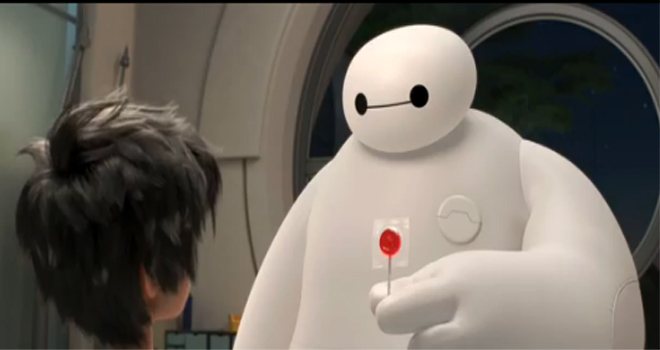
How about a candy? Can it make you happy?
Adapted from http://o.aolcdn.com/
This seems like a rant, no? Well, maybe it is. But, and this is a big BUT (get it?): It doesn't mean that I hate this film. No, on the contrary, I liked this film, not only because it is entertaining, but it is a somewhat mature animated film, with a lot of deep meanings inside, despite the fact that films of this kind are more intended towards younger audiences, and are targeted as such.

Big Hero 6
Adapted from fandago.com
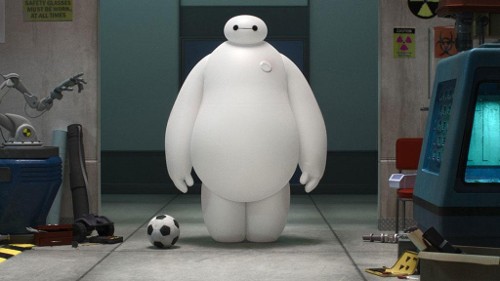
Okay, okay, I admit it, I love this film mostly because of Baymax. If it wasn't for this cute, squishy, huggable, white-marshmallow-ish robot, that looks like a combination of Eve (from "Wall-E") and the Michelin dude, then this film will undoubtedly lose some of its appeal, much like "How to Train Your Dragon" would if it didn't have Toothless as its star dragon. The contradiction between Baymax's flat, emotionless voice with his genuinely kind and selfless actions and intentions just make this big white robot a whole lot more lovable among the entire cast, and as such, it remains fresh in my memory. And then there is his calm demeanor in which he faced even the most dire situations which creates a lot of genuinely funny scenes, especially in how he moves about with his bulky body size, or how he wants to do a full body scan every time he met a new person (he is a medical robot), or how he acts like a drunk when he is low on batteries. To put it in non-fanboy-ish terms: Baymax is cute, and I probably should stop listing out the obvious facts of how lovable this robot is, before someone decides to kill me.

Baymax is cute
Adapted from yahoo images

I have recently observed that Disney has a sudden shift of orientation that tend to include minorities as their protagonists. From the all white cast in "Snow White", to "Mulan", "Lilo & Stitch", "The Princess and the Frog", "Up", "Frozen", and this film, the change in perspectives is perceivable, and it is certainly pleasant to know that a multinational mega corporation decides to, you know, include a larger and more diverse group of people into its ouvre. One can only hope that more and more of the diversity of our culture can be succinctly and fully portrayed in its multidimensional nature, and as psychology undergraduates, we are constantly reminded of the "multicultural lens" at which we need to acquire if we are to successfully venture out into the world as psychologists, psychotherapists, psychiatrists, counselors, or sociologists. Unlike our ancestors, who lived in self-contained societies without the awareness of the global population, we must be aware of the world as such, so as not to lose sight of the differences between each and every culture, and yet at the same time perceive the similarities that make us all, you know... human. No matter if you are an Asian, a Hawaiian, an African American, a senior citizen, a woman, we are all humans, and deep down, within us, we are all humanists if we are to combat racism, sexism, and the many other -isms.

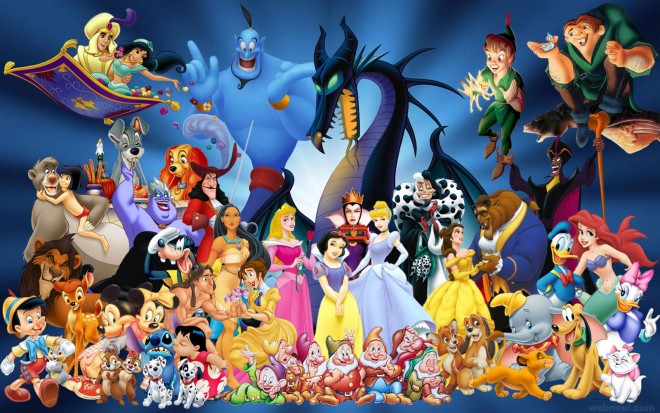
Disney Cartoon Characters
Adapted from webneel.com

Baymax was asking Hiro to state his emotional state
Adapted from Thenypost
It is certainly delightful to see Disney, a cartoon company, an entertainment industry, start to take up the mantle in producing superhero movies (they recently acquired rights to produce Marvel movies). One can only anticipate how they will make superhero movies with a Disney spin (please no musicals, please no musicals, please no musicals...). And like many Disney movies, the human emotions, and the intimacies between each and every character is palpable. But make no mistake, "Big Hero" is no "The Incredibles". In "Incredibles", we see a dysfunctional superhero family, one that strives for normalcy but fails inevitably due to the ideals of being superheroes that permeates every aspect of their dream for a normal everyday life. "The Incredibles" is a deconstruction of the ideals of being a superhero in a world where being a superhero is a nuisance and at best an unwanted profession. But "Big Hero" practically basks in the glory of being one (or rather, as a team). It drowns itself in all the stereotypes and generalizations of what it means to be a superhero, and glorifies each and every aspect of being one. One can almost hear Uncle Ben at the background, shouting "With great power comes great responsibility", while adding, "But have fun while being one". As such, there are no meta-fictional accounts, and no analyses in "Big Hero", because how do we even analyze a film when it takes itself so seriously? Does this make "Big Hero" inferior to "The Incredibles"? No. But it does detract some of its entertainment (and not to mention, its academic) values.

Adapted from thenypost
Notwithstanding my own slightly skewed outlook towards "Big Hero", it is in fact a sufficiently entertaining movie in itself, one that kids and parents will simultaneously enjoy, while offering a deeply moral story of family, revenge, and grief. In almost every Disney movie, there are losses, and then there are malfunctioning ways of coping with this loss (the most recent example is "Frozen"). But what matters is not the imperfections of the characters in these stories, it is what they learnt that matters, and as witnesses of change, we see them change and grow up, and we change and grow up too alongside these heroes that we held so dear to our hearts. And then we will realize that, just as big heroes come with small sidekicks, we, the heroes of our own stories, need these small heroes as well, to grow, to learn, and to explore this world.

Adapted from oyster.ignimgs.com/

Tuesday, 11 November 2014

Movie Review: "Interstellar"

In a cosmic scheme of things, our actions are but nothing, and all our struggles and sufferings are reduced to an insignificant nuisance. A sudden supernova, or the onslaught of a black hole and everything we once cherished will be gone, forever, in the blink of an eye. Humans like to find good and evil in everything, even in Nature itself, as if attaching labels to it comforts our anxieties towards a mysterious phenomenon in itself, as if it makes the Unknown known. But Nature doesn't care, it is indifferent to our survival. One can't say that Nature is good anymore than one can say it is evil. To label and call it thus is to commit the folly of anthropomorphism at its highest order, a human tendency to be exact. If one day the human species is to be extinct, the Earth wiped back into a clean slate before the arrivals of the first homo sapien, the universe will not care.


Faced with such an indifferent and occasionally destructive universe, we are forced to find our survival on Earth through our own pondering and adaptability. And so we come to tame Nature, the one and only untameable entity. We come to force Nature to do our bidding, to take into our own hands as we see fit, and to harness resources to ensure our survivability. This is all good and well, after all, we did survive millenia through our "intelligence" and consciousness didn't we? This anomaly in Nature, this sudden mutation, this human species, has suddenly become the apex of evolution, and acquired a hubristic view of our own capabilities, and constructed an ever optimistic view of progress. But what if our pleasures of the here-and-now, the present, obstructs a longer view of the future? What if we aren't prepared for the consequences of our current debauchery? What if the myth of progress is ultimately a fiction? We love to live under fictions, stories constructed to veil us into action, so that we will not lose our sight on what is deemed socially appropriate. Because Truth, the hard Truths that are potentially devastating, are seldom welcomed. Much like what Nietzsche said, we only accept the Truths that we would like to accept - harmless Truths.


Now, more than ever, we are increasingly aware of the possibility of a wide-scale extinction, because of our out-of-control waste of resources. Nature is a self-correcting system, a system that will rebalance itself to accommodate its current situation. What comes around, goes around, and we will pay for our own debauchery. It is in such terms, that we come to grips again  with the notion of our survival. But what is survival? Is it the survival of the species? Or is it the survival of the individual? The contradictions between the absolute and the relative are irreconcilable, as one is the achievement of an absolute end through the deployment of every means, while the other is much more harder to realize. To realize the former, one merely need to colonize another inhabitable planet, and through the risk of playing God, one creates a "New Earth", while disregarding the survival of those that are left behind. The latter is harder to realize because to do that, we must move our entire species (a few billion people, not much) to another planet, while the former is efficient in that we need only a few cells, and a few test tubes. It all comes down to what we cherish, the survival of those around us or the survival of a species in its entirety. But as human beings with the baggage of emotions, can we really come to the cruel decision of surviving a species, an abstract conception at its finest? Are we not bound to those that we love ultimately, and to save an impersonal species that we may not meet in the future, doesn't that seem all too detached from us? To gain a larger perspective, to see the survival of the species as our final goal requires us to have the vision of God, or to be simply, a madman, one that will incite scorn, however noble our goals were.


Do not go gentle into that good night,
Old age should burn and rave at close of day;
Rage, rage against the dying of the light.

This stanza from Dylan Thomas' poem, "Do not go gentle into that good night", is recited throughout the movie. And through its multiple recitations at different points of the movie, it creates a repercussion that is still felt in me several hours after the viewing of the movie. In its simplest interpretation, it is a reminder that we, and the characters in the movie, shall not forget the true goals of our species as a whole, that we shall resist our extinction with a full blown rebellion, a "rage" that will burn even God and the universe, so that we can achieve survival, to defy the "close of day" and the "dying of the light". Such is the power of our drive to survive. But our struggles on a cosmic scale are but a parable to our personal struggles, and it is only these that matters, as we face a vertiginal sense of futility in the face of the universe. And taken on a more personal level, doesn't the stanza itself also meant death, and the tyranny of Time?


Because despite its cosmic contemplation, its wide panorama of beautiful astrological entities, its dazzling vistas of the universe (the wormhole in particular), its philosophical view of mankind's survival, civilization, and progress, and its dizzying techno-babble on quantum physics, aerodynamics, and astrophysics, the film is, in its naked form, a film of our human condition, one that is personal, and filled with more humanistic themes rather than scientific ones. It is a film about loneliness, separation by long distances, and desperate longing: a loneliness of a father separated from his son and daughter by who-knows-how-many lightyears away; the loneliness of a man stranded on an alien planet, despaired by the lack of human contact; the loneliness of a woman, longing for her lover, with the certainty that he is dead in another planet. It is also a film about how we fill up the gap of our loneliness, because Cooper, the main protagonist, who left his daughter behind in order to find a new hospitable planet to replace the decrepit and dying Earth, and Professor Brand, who let his daughter went on the mission, essentially exchanged roles in that Professor Brand now acts as a surrogate father to Murph, the daughter-left-behind, and Cooper now acts as a protector of Amelia Brand, the daughter of the professor. It is through these pseudo-relationships that they found intimacy: for the professor, he can finally exercise his paternal love now that he has lost his real daughter to the vacancies of space; as for Cooper, a human contact in the deep silence of space is all he can cling for, in order to not lose his sanity to the vast quietude of the vacuum.


But ultimately, I think, it is a film about Time. Time, in a traditional sense is linear in structure, as we move along the constant lines of Past, Present, and Future. But with the introduction of philosophy and more recently, quantum physics and quantum mechanics, we get a more and more complicated and convoluted picture of Time. I am no quantum physicist or astrophysicist, so I have no reason to display my ignorances here in order to convey false messages, and can't confirm the scientific accuracy of this film. But this much I know at least: in that Time is a concept that we are, implicitly or explicitly, aware of, and the passing of Time is as much a source of anxiety as it is a source of despair. Professor Brand once proclaimed a witticism in this film that is tinged with obvious hints of fear, that "I am not afraid of death. I am an old physicist, I am afraid of Time." We fear Time because with each moment passing away, our body rots a bit. And with each breath I took, I gain some life, I live for a moment longer, but I take one step further into the realms of death.


The penultimate usage of the notion of Time is precisely in the film's usage of Einstein's theory of relativity, in which "time dilation" creates "an actual difference of elapsed Time between two events as measured by observers either moving relative to each other or differently situated from gravitational masses". What this means is that if there is a difference of gravitational pull and or velocity between two different places, then it will bend Time (spacetime) and distort it, making Time on both places run at a different pace. So in the film, there is a moment where Cooper and co. landed on a planet that floats beside a rotating black hole, making the gravitational pull there immense in contrast to Earth's, and the implications for this is devastating, as an hour on that planet constitutes seven years on Earth. With such knowledge, comes a heavy burden on how we use that Time. Because every moment is monumental, every minute is the passing of several days, or several months elsewhere. As I sit here on another planet talking with my friends, people on Earth is dying of respiratory problems or facing extinction. We usually take Time for granted, because for all we know, Time will continue to flow on... until that is, if we faced the immensity of Time, or if Time ceases to flow again. But if Time is relative, so too are our human interests. That's what makes life itself interesting isn't it?


Somehow I suspect that this film is a personal one for Nolan. Because in his previous films, with the possible exceptions of "Memento" or "Insomnia", all his films are of an impersonal nature, constructed with the precision of a statistician or a logician, without much care for his characters. Rather, the emphasis is on the storyline, the plot, the screenplay. As much as I admire "Inception", its cold atmosphere can't suck me in and immerse myself within it like "Interstellar" can. Maybe it is a sign of maturity, or maybe it is because of the brilliant and intense portrayal of Cooper by Matthew McConaughey (I have loved his acting since "Dallas Buyers Club" and "True Detective"). Maybe...

Christopher Nolan
Matthew McConaughey
But in watching this film I was reminded once again of the amazement, wonder, and awe in the face of the universe, when I watched Kubrick's marvelous "2001: A Space Odyssey", or Carl Sagan's "Contact" and "Cosmos", or last year's magnificent "Gravity". All these differ in their themes, but all of them unite in that they all portray the beauty of the universe, the transcendent nature of our cosmic contemplation, as well as the horrors of a vacuum space, and the insignificance of our trifles in the face of such magnificent indifference. All of them simultaneously combine the horror with the beauty, the smallness of our being, and our capabilities to perceive, even if only for a little, a glimpse of the nature of the cosmos.


We are explorers on Earth during the dawn of Time, and someday, maybe not too far in the future, we may be cosmonauts, living, travelling, and even conversing with other, maybe higher, beings. But until that day, we must concern ourselves with this Earth, tend to and care for this home which has catered to us since our beginnings. For now, we are nothing in the face of the absolute immensity of the universe, the abyss that is our surroundings, as our rage is not enough for us to be ravaging conquistadors, and old age is our symptom, so we will always go gentle... into that good night, into that eternal slumber that awaits us all at the end of our short journey.


Friday, 24 October 2014

Movie Review: "올드보이 (Oldboy)"

"Laugh, and the world laughs with you. Weep, and you weep alone."
- Ella Wheeler Wilcox, "The Way of the World" 
(Quoted in the movie "Oldboy")


[Warning: Extreme violence, and contains sexually explicit scenes, not for the faint-hearted.]

The South Korean movie industry is perhaps one of the most misunderstood movie industries in the world. It's somewhat true to an extent that the South Korean media often produce sappy soap dramas, filled with fatalistic romance encounters, forceful tear inducing scenes, repetitive ballads that sing about unrequited love and tragic fates, car accidents, amnesia, the sudden revelation that your lover is actually your sibling (gasp!). Korean dramas are often so cliched to the point that one wonders why everyone even bother to watch it, since every (and I mean every) drama has roughly the same plots, the same character-types, the same setting, even similar songs sung by similar artists......

All sunshine and roses, the melodramatic bubbles of soap
But that's beside the point, what I am about to review here, is simply put, one of the most mind-bending, shocking, tragic, and disturbing films that I have ever had the fortune (or is it misfortune?) to watch. "Oldboy", or pronounced with a Korean accent, "Oldeuboi", is a masterpiece, at least in my opinion, that is. It marks a turning point in the Korean movie industry in that it spawned a series of revenge thrillers, similar in genre, but different in its mechanisms, such as the equally masterful "달콤한 인생 (A Bittersweet Life)", "아저씨 (The Man from Nowhere)", "추격자 (The Chaser)", "황해 (The Yellow Sea)", "악마를 보았다 (I Saw the Devil) [Another favorite of mine]", "똥파리 (Breathless)", and many more.

(Most Korean revenge thrillers are notorious for their sado-masochistic violence, which present their bloodshed and tortures with an unflinching view, so beware, oh those who dare to enter. For once you get past the initial rites of entry, you will not leave unscathed. Come to think of it, such is the desensitization towards violence of contemporary times. Ah, the irony.)


Although "Oldboy", once considered the most violent and the most sexually explicit Korean film there is, is now superseded in its content by many Korean films, such as "I Saw the Devil", where its ultra-violent content has far surpassed that of "Oldboy", it is still considered controversial because of its highly tragic content, which I will not reveal here for fear of spoiling the enjoyment of viewing this film in its entirety. It contains one of the best endings I have ever seen, and the execution of this is admirable, and not in the least bit disappointing , despite its awful revelation. In my humble opinion, the ending ranks up there along the likes of "The Shawshank Redemption" or "The Prestige", albeit the two plottwists are entirely different, one tragic, the other euphoric. Other endings nowadays, such as from the films "The Usual Suspects", "Now You See Me", or even "Insidious", are entirely unsatisfactory when compared to "Oldboy", because these lack the crucial motivation of the characters (even if they have it, it is as shallow as it comes), ingenuity, and are entirely forceful while being unnecessary to the viewing experience, while the plot in "Oldboy" flows naturally, and the ending, necessary, and vital.


"Oldboy", a 2003 South Korean film, directed by Park Chan Wook, tells a horrifying story of a man, seemingly innocent, being kidnapped and confined in the same hotel room for 15 years without knowing the reasons of his confinement. And so he trained himself in the room, preparing for the day when he is released in order to seek vengeance upon his unknown captors. As if his imprisonment isn't mysterious enough, he is also mysteriously released and is told by his captor that he has five days to find the captor, and to search for the reason of his imprisonment. This is made all the more complicated as after his release, he falls for an attractive sushi chef. Thus begins his bewildering and bizarre journey of self-exploration.


Oh Dae-Su, the protagonist of the film, portrayed brilliantly and intensely by Choi Min Sik (who also portrayed the serial killer in "I Saw the Devil"; I call him the Eastern Marlon Brando), is not a person who you will define as a hero. In fact, he is an anti-hero, a despicable human being, an alcoholic who skipped his daughter's birthday in order to drink soju, who winded up in a police station for his drunk behaviors, displaying there his wild antics, before being kidnapped mysteriously. But for all his misbehavior and his totally rugged personality, we come to relate to him, for he is like one of us: imperfect, occasionally unruly, flawed. And when Oh is plunged into a web of conspiracy, where everything takes on a mysterious mask, where nothing is as it first seemed, we are confused along with him, and we can but watch helplessly while he walks the path of self-destruction, towards the ultimate tragedy: revenge.


Vengeance, one of the most satisfying of all human notions, is at once a despicable act, shunned by Buddhists, Christians, and most religions as well as ascetic philosophers alike for its harmful effects not only upon others, but upon oneself. But it is not without its cathartic effects; that we cannot deny. In fact, we feel a sense of justice as being served as we witness the downfall of another corrupted person. The proverbs, "revenge is a dish best served cold", or "an eye for an eye," which came from unknown ancient sources, paints revenge as a satisfactory act. But then again, another proverb, which states that, "Before you embark on a journey of revenge, dig two graves," is equally true, for one does not simply avenge oneself without the forethought of a possible death of oneself. You see, in an act of revenge, you gain satisfaction after the enactment of vengeance, of violently pushing the other towards his downfall, or his death, but what does that make you afterwards? Won't you become the same as the now-fallen person? And then, what next? Retribution does not simply end here, for the person's heirs or friends will avenge the fallen person with similar wrath. Revenge is at once the most intimate act, an act of destruction in close-range, where one taps into unconscious reservoirs of primal instincts. But it is simultaneously an act of decay, the decadence of morals, of one's self. For once the deed is done, the cycle continues, until one party completely collapses.


Perhaps it is as Machiavelli once said in "The Prince": “People should either be caressed or crushed. If you do them minor damage they will get their revenge; but if you cripple them there is nothing they can do. If you need to injure someone, do it in such a way that you do not have to fear their vengeance.” But the world is seldom so perfect, and people often didn't get their own say on how tomorrow will turn out to be. The world is indifferent towards our goals, our motivations, or our notions of good and evil. Unlike what Leibniz once said, that "this is the best of all possible worlds", the world is a cruel place, and harsh towards the innocent. And Oh Dae-Su, at once the most oblivious person, may embrace this fact with vigor.


And this is not only a film about a person's journey of self-destructive vengeance, it is also a tale of the consequences of our actions. Similar to what chaos theory proposes, that the smallest differences in initial conditions may yield a wide range of different outcomes (often unexpected and unpredictable), so too are our actions. I recall a news that happened several years ago (I forgot where), that an adolescent was forced to bleed him/herself to death after rumors started spreading that he/she was homosexual (which is in fact true, but this doesn't make the deed all the less horrifying). Such are the consequences of our behaviors, that the most insignificant act, can lead to disastrous catastrophes. And by the end of the movie, one may question whether Oh is as innocent as it first seemed, or whether the faults are piled upon him by others, forcefully.


But perhaps the one theme that I liked the most is Oh Dae-Su's obsession towards death. People who seek vengeance, who have nothing else to lose, have an obsession with death. They are enthralled by it, moved by it, revolted by it, yet helplessly lead by it. They proceed towards the destructive act with a tunnel vision, seeing nothing else but the notion of retribution, the death of others above all else, without regarding their personal well-being. Death for them is paradoxically both a rapturous ideal, and a rupture in their being. And this is the case with Oh, for after 15 years of imprisonment, he is anything but "alive". Though he is breathing, moving around, he "lives" like an automaton, or to use his own words, "a monster", a monster created not only by his captors, but molded too by himself; a monster with only one goal in his life, to see the annihilation of his captors.


Consider one scene where Oh Dae-Su was fighting a whole alley of people (a one-shot scene, a remarkable cinematic achievement). Never for once did he waver, the planks hit him, the knives stabbed him, the punches landed, and he fight, on and on and on. It's as if he is possessed, a monster clothed in human skin. The obsession for revenge is so palpable that one can see it, even smell it, in his punches and between his breath. He has a tunnel vision, a vision for revenge, and not even a stab in his back can stop this. He breathes vengeance, it fills him. But one wonders what will become of him once his appetite for vengeance is satiated.


One particular scene especially moved me, for after his release, when he walked into the sushi restaurant, before his fateful encounter with Mido, the aforementioned attractive sushi chef, he ordered live octopus (which is a delicacy in Asian countries, termed in Korea "sanakji"). What he then did is horrifying, yet saddening. Oh devoured the octopus in an unusual way, for he grabbed the octopus, tore with it with his teeth, consuming it while the living octopus is still living, grabbing Oh's hands and his mouth with its tentacles. And Oh briefly suffocates due to the blockage of the throat by the octopus. What he did here was not a simple act of eating, he consumes the octopus for he craves life. But his craving for life is not genuine, for it is artificial, just like a drowning sailor who gasped for air before the water sets into his lungs. He yearns for it, after 15 years of complete isolation, where he lived not like a human being, but rather like a dog, an animal encased in a hotel room like a prehistoric mosquito in amber.


Just like what Rust, the character in "True Detective" said, "My life's been a circle of violence and degradation long as I can remember." The same can be said of Oh Dae-Su, for he doesn't live, he prowls, he survives the violence and degradation, in order to create more of it. His life is nothing but a Shakespearean tragedy, as he moves along the lines of fate predicated by Destiny, by the Deus ex Machina. The film explodes in all directions, all equally miserable, as Oh Dae-Su plunges into the abyss, the darkness that is within him, while the film lays bear everything his mind and heart has to offer, and strips him until all there is left is his insanity.

And for that, we pity him, for he weeps alone, and laughs alone.


(Don't watch the 2013 remake, or if you really want to, watch the original Korean version first. Because the American remake is incomparable with the original, and loses its obsession, its atmosphere; it is essentially Americanized. Now don't get me wrong, I have no issues with remakes and have watched countless superb remakes, but this remake in particular is not good. Unless you are watching Elizabeth Olsen, then go ahead.  :D)

I have found my Goddess!


Friday, 10 October 2014

Movie Review: "The Fly

There will always be that one book, that one DVD or that one piece of artistry in which you won't have the courage or motivation to open and confront it face to face. For me, that one film is the one that I will discuss today, and that film is David Cronenberg's "The Fly".


Ok.... I admit it, I am scared to open it, given that I have viewed countless gruesome images of the film, and am particularly afraid of the notion of watching a man slowly and painfully transform into...... something else.

See what I mean...
I had downloaded the film for about a year and a half (yes, I am a pirate!), and it sat in my hard disk, and was left forgotten. Or at least I thought so, because there are moments when my unconscious self started to seep through my well barricaded self, and I am driven mad by an impulse to just forget my own considerations, and to satisfy my insatiable curiosity. Yet, that plan never sufficed.

It was not until last month when I finished Franz Kafka's nightmarish "Die Verwandlung (The Metamorphosis)" that I can even put aside my irrational fear of gruesome metamorphoses, and finally plant myself in front of the laptop, and sit through the whole horrifying 96 minutes of the movie.


What a breathtaking movie it is (albeit simultaneously horrifying and absolutely heartbreaking)! It not only signifies a very dramatic cinematic achievement in costume designing and make-up techniques, but also, its very humanistic elements is what established this movie as one of the landmarks in storytelling. It manages to subside the very threat that many sci-fi movies had succumbed into, which is to make this film into a "freak show".


Adapted from a short story written in the 1950s, this movie takes the already horrifying notion of unwilling transformation to greater heights. There are many parables to this masterful film, with Kafka's haunting novella "The Metamorphosis". Both of their main characters (Gregor Samsa from "Metamorphosis", and Seth Brundle from "The Fly") confronts an absurd situation in which they are transformed (or transforming) into an insect, and this catastrophic phenomenon not only change their lives, but rather calls to question of what it means to be a human.


Does the new body signifies the death of the old mind? Does the acquisition of new "insectile" instincts nullify our human cognition? But these questions would not seem proper, as in both "Samsabeetle" and "Brundlefly" we can still retrieve traces of our human thinking and of their compassion and dignity that signals an all too human emotional state. What then, does the transformation signifies? Does it signify their spiritual impoverishment? Or does the transformations act as a metaphor for their aging bodies? Or is the more famous interpretation of it serving as a metaphor for AIDS correct? All these questions will only sprout further questions, but I think one of the central questions is the meaning, or should I say requirements, for us to be human.


What does it mean to be human? Is it the ability to perform maths? Is it the ability to perform miraculous acts through the name of science? Or is it the ability to feel compassion and empathy towards another? What if we suddenly acquired a super human ability through the fusion of our human cells with that of another species (for example say a spider)? Does that make us all the more human, or does it make our human qualities dormant as our new animal/insect instincts arise and take over our body?


All these questions lay to rest when we just simply put aside our constantly spinning mind and just sit there and witness the pain and morbidness of Brundle's transformation into a fly through an experiment gone wrong. Yes, we feel pain for him, as we observe his losing capabilities to chew and absorb normal food, as his human physical traits slowly deteriorates and decay while his "fly traits" gradually emerged. We feel hurt for seeing him turn from a promising genius into a creature who takes pleasure just by spitting out his acidic fly enzyme or by crawling around on his bedroom ceiling. We feel heartbroken as we watch his lover, slowly exposed to the horrific truth that her lover will never return, and that Brundle will no longer be human, nor fly, but an altogether new being that cannot (and will not) be classified.

From this...
To this.
But does Brundle feel pain? It is not evident in his behaviors and expressions that he felt pain at all. In fact, he seemed quite amused by the prospect that he can hung upside down from his ceiling, and even collected his decaying and fallen human body parts, displaying them on a shelf and calling it the "Brundle Museum of Natural History". Does this mean that Brundle is not afraid of his impending fate?


I cannot give the answer, but perhaps consider the following scene I will describe and interpret it as you will. In this chilling and climactic scene, Brundle tell his lover of his current state, and he described it by saying, "I'm an insect who dreamt he was a man and loved it. But now the dream is over... and the insect is awake. I'm saying... I'll hurt you if you stay."


In just a few sentences, the movie manages to transcend itself as being just a typical sci-fi or love movie, and instead it addresses the human condition with all its bluntness and fatality. The phrase is all the more heartbreaking because we too realize that we are facing similarly metaphorical situations in our lives. Everything is a dream, and one day, sooner or later, we will have to wake up, what then do we do? Hide in despair? Or transcend it, by becoming an "Übermensch" as Nietzsche envisioned? Perhaps there are no answers to these questions, and I am just here trying to confuse myself to death.


But what a great film this is, in that it provoked so many questions in me! That the possibility that I will never acquire answers to these questions never bothered me in the slightest, and I am grateful that I am still able to see such thought provoking movies in my lifetime. These pleasant feelings is equally mixed by my guilt for not being able to bring myself to watch this film much earlier on.

Perhaps we should be grateful for the fact that this might not ever happen in real life (or is it?). For one, Brundle has already clearly stated it in such direct fashion, "Have you ever heard of insect politics? Neither have I. Insects... don't have politics. They're very... brutal. No compassion, no compromise. We can't trust the insect..."


And neither will we.


Monday, 29 September 2014

Movie Review: "Cinema Paradiso (Nuovo Cinema Paradiso)"

Great movies are great when the people who watched them can understand and relate to them. Needless to say that “Nuovo Cinema Paradiso” is a great movie, and is often applauded by critics and the masses alike because its themes and narratives reach out to the people and offers a warm and humanistic view of our human existence.


First and foremost, this movie is a movie that describes the simplest and most basic of our human emotions, love (though not in a conventional sense). It is about the love between a child and movies. It is about the love for the place in which they are born in (although this is mixed with a pinch of loathing, but hey, what is love but the most complicated of all emotions?). It is about the pure and innocent teenage love between a man and a woman. But most of all, it is about the love that sprouts like a disease between two men, one a wide-eyed and curious boy named Toto, and the other a man hardened by years upon years of work, and wise to the realities of the world, named Alfredo.

Toto (young)
Toto (old)
Alfredo
Like most epic romance movies, it is similar to “Gone With the Wind” and “The English Patient”, in that love is only a background for the main stories that take place in it. “Gone With the Wind” describes a woman’s ambivalent love towards a man, while describing the Civil War era; and “The English Patient” similarly depicts the destructive love affair between a mysterious man and a determined woman, while portraying a vivid picture of the final years before World War I and II. And like those two movies, “Cinema Paradiso” depicts a love that is all encompassing, passionate, while including detailed descriptions of culture, ideologies, and redemption.


Let us start from analyzing the love between Toto and Alfredo. The two are the most unlikely duos of all time. As one is a mischievous and “foxy” (as described by Alfredo) boy, estranged at home, and found his love for movies while watching Alfredo work in the projecting booth. The other is a wise and eccentric old man who loathes his work, yet at the same time embraced it as if he was born to do it. Together, they form a “Tom & Jerry” like relationship, in which Toto tries to elude the other’s beatings while Alfredo chases Toto away so as not to end up similarly like him, with a lonely life and a difficult lifestyle. But it is easy to see the affection both have for each other. And like many other children who lost their father, Toto discovered a haven in the projection booth and in Alfredo’s presence, forming an attachment with Alfredo that is both poignant and moving, while creating a pseudo-parent-child relationship with each other, after they decided to put away their conflicts and embrace each other’s presence (which is enhanced since Alfredo doesn't have children, and found the potential for parenthood in Toto).


In some ways, the relationship between the two reminds me of the relationship between Santiago and Manolin in “The Old Man and The Sea”. While Santiago is a romanticist and has a very positive outlook both on his life and his constant struggles with mother nature, especially the sea, Alfredo is much more critical of his time and has a much more cynical view on life, which is all the more potentiated by the difficulties he faced in life (the accident in the booth). But what is similar between the two is the touching love they have towards the children figures in their story. As demonstrated in the final scenes of “Cinema Paradiso”, Alfredo still loves Toto very much, and is all he can think of even at his deathbed.


Now we shall return to discuss Toto’s love for the movies. Maybe it is because the escapist qualities a movie has that allows people to dwell in fantasies that attracted Toto to it, or maybe it is because in a projection booth, Toto finally finds a fragment of home which he will never find in his own estranged home. Maybe. But what can be known is that Toto loves movies, and movies during those times are as rare as gems, as there were no TVs, no DVDs, and no video players that can allow a person to watch movies anytime they want. There is only one place for it, and it is through the projection of light through the hole in the wall, that people can finally witness the magical qualities of cinema. And so, all sorts of people crowded into the cinema, ranging from a priest that rings his bell at every “obscene” scene (actually, the movies only have people kissing, just imagine what he would do if he is living in this decade), to a crazy that proclaims his ownership of the city square and chases people off during midnight. There are those who sit at the upper level of the cinema (who think they are of a higher class in their bourgeois banality) who spits at the cheering crowd below, those who cheer and shout and laugh and cry at every scene of the movie, children who masturbated at beautiful women on the screen. You would think by watching this movie that every Italian is loud and boorish, and wear their emotions on their sleeves.


One other love that deserves  noting is the innocent and beautiful love between Elena and the teenage Toto. In many ways, this love reminds me of the doomed love of “Romeo and Juliet”. And ironically it is Elena’s father who separates the two apart, just because he believes that Toto doesn't deserve Elena due to his lower class birth. But the love is quite impacting because it is Toto’s first love, and it is actually quite cheesy (as with many other adolescent love). Putting aside its cheesiness, this short relationship actually affects Toto a lot, and it is actually one of the pivotal reasons that motivates Toto to move on to Rome and pursue his dreams.


But the love stories in Toto’s life only serves as a single theme, as this film also deals with the idea of sentimentality and nostalgia. In many scenes, we can observe that Toto is driven by sentimentality and lingers in the past just because he couldn't let go of it, as the past is most often than not, the most beautiful parts of our life. There is a great deal of nostalgia involved in the movie, as it seems that the director himself is nostalgic of the simple and innocent past, where everything isn't as complex as it is now (the film is actually partly autobiographic). But what Alfredo conveys to Toto is that we should crush the past and move on, to embrace a pragmatist view of life and to walk down a path that is rooted in realism. It was Alfredo that encourages Toto to go to Rome, to let go of the past, and to move on in his life so that Toto can fulfill his life’s dream, to become a director. Alfredo is not only the father figure to Toto, he is the Socrates to Toto’s Plato, the Julius Caesar to Toto’s Augustus. In one touching scene where Alfredo says his final goodbye to Toto at the train station, we can see he is as equally tortured as Toto to depart from each other. But when he whispers in Toto’s ear, “Don’t come back!” we can see his determination.


There are many poignant and moving scenes throughout the movie, and one in particular moved me to tears, which is the scene where Alfredo teaches Toto how to broadcast the movie to a crowd outside the cinema. As Alfredo slowly deflects the projector’s light to a building outside, and as the small screen slowly moves through the walls to reach the building, it is obvious that this should be one of the finest scenes in movie history. But what is all the more heartbreaking is that this momentary happiness will end as soon as it starts. And this is where the movie thrives in, as it lets us to witness the beautiful parts of our nostalgia, while forcing us to never give in to it, and face our constantly changing reality. The message is this, we should move on, and let go of the old past. This message cannot be more clear, as when the cinema (itself named “Nuovo Cinema Paradiso”) is demolished to pave way for a new parking lot. And when the final scenes reveal itself, we witness Toto revel in the deepest depths of Alfredo’s love towards him, as he comes to terms with the past and tie up all loose ends, and make way for the future.

One of the most moving scenes in the history of film

This should be a movie that I find all movie-goers and cinephiles will love to see. And much like the movie “Hugo”, directed by Martin Scorsese, which features another equally mischievous boy, embarking on a journey to help one of the world’s first filmmaker, Georges Méliès, to help him regain his passion in movies, “Cinema Paradiso” is just as magical and enchanting in its narratives of hope and happiness.


But what is the most important message is seen when Toto went back to Sicily to attend Alfredo’s funeral, as when he discovers after 30 years of departure, that everything has changed.

Yet, at the same time, nothing has.

One of the finest endings ever